The governed preparation layer before AI implementation
You want to adopt AI—without losing control. Start with the workflow, not the agent.
Controlled AI Worker Blueprint Studio turns fragmented SOPs, policies, emails, transcripts, and operational knowledge into an approved operating baseline and a governed implementation specification. It defines where AI may assist, which rules must remain deterministic, where people retain decision authority, what systems AI may access, and what remains unresolved.
An AI agent is not a workflow. Blueprint Studio closes the preparation gap.
Blueprint Studio prepares the submitted workflow for implementation. It does not select the best workflow across your organization or execute the workflow in production.
- 1
Evidences / SOPs
Workflow source material - 2
Approved SOP
Controlled operating baseline - 3
Controlled Blueprint
Governed implementation handoff - 4
Automation System
Selected execution platform or custom runtime
Make your workflows ready for AI
The barrier is no longer building an agent. It is agreeing on how AI may participate in real operational work.
Organizations want to put AI to work in increasingly complex operational processes. But security, data privacy, legacy-system integration, human oversight, and accountability make responsible implementation difficult.
Execution platforms can run a workflow. First, the organization must agree on what should be implemented.
n8n, Make, Zapier, Flowable, Camunda, and other workflow systems provide execution capabilities. The unresolved questions come earlier: which policy is authoritative, where AI is useful, who retains authority, and what controls implementation must enforce.
THE CRITICAL DECISIONS ARE STILL SPORADIC
Is this workflow suitable—and ready—for AI?
Which parts should use AI interpretation or reasoning?
Which rules must remain deterministic?
What information may the AI read or change?
Where is human review or approval required?
How should exceptions, permissions, and audit evidence be managed?
The preparation layer
Prepare the workflow before you automate it.
Blueprint Studio brings together existing SOPs, process notes, comments, messages, emails, scripts, transcripts, and meeting summaries. It identifies contradictions and missing decisions, then converts that evidence into a governed, reviewable implementation package.
- 1Canonical SOP
A comprehensive version of how the workflow should operate.
- 2Approved operating baseline
The agreed source of truth before automation begins.
- 3Controlled AI Worker Blueprint
AI responsibilities, rules, approvals, boundaries, exceptions, and audit requirements.
- 4Structured implementation handoff
Definitions prepared for automation and workflow platforms.
Who it's for
One shared blueprint for every team involved.
Blueprint Studio is for organizations that see valuable AI opportunities inside real operational workflows—but need business, technology, and control teams to agree before implementation.
Operations & process owners
Turn tribal knowledge into an approved operating model.
Clarify the real workflow, exceptions, ownership, and completion rules before automating it.
YOU GETConsistency, ownership, and fewer hidden assumptionsAI enablement & transformation
Define the safest useful role for AI.
Evaluate the submitted workflow, identify control gaps, and establish a phased pilot posture.
YOU GETA defensible recommendation for this workflowEnterprise & solution architects
Expose integration requirements before development.
Receive structured states, responsibilities, identities, permissions, and unresolved bindings.
YOU GETA clearer implementation scopeTechnology & automation teams
Start from an approved operating model.
Receive states, rules, approvals, exceptions, tool requirements, tests, and machine-readable artifacts.
YOU GETLess discovery rework and a clearer build scopeSecurity, risk & governance
Review the trust boundary before systems are connected.
See allowed reads, later writes, blocked actions, permission needs, approvals, and audit events.
YOU GETVisible controls and fewer late-stage objectionsConsultants & integrators
Deliver a stronger discovery and implementation handoff.
Convert interviews and client evidence into a consistent, governed package across engagements.
YOU GETA repeatable method and higher-value deliverableOther problems it resolves
Once the preparation gap is visible, the other risks become easier to solve.
Blueprint Studio also closes the operational gaps between how work is described, how it actually runs, and what implementation teams need to build it responsibly.
No approved source of truth
SOPs, emails, meeting notes, and actual practice may describe different versions of the process.
AI capability without defined authority
A model may be capable of interpreting or recommending without being authorized to decide or act.
Exceptions remain informal
Happy paths are automated while approval failures, missing data, outages, and prohibited actions remain undefined.
Governance arrives too late
Identity, permissions, privacy, audit, and write authority are often discovered after development begins.
Business and implementation speak different languages
Process owners describe procedures. Delivery teams need states, rules, interfaces, permissions, callbacks, and tests.
Platform decisions shape policy prematurely
The operating model becomes constrained by one runtime before the business approves how the workflow should work.
What you bring. What you get.
Start with the evidence you already have.
You do not need a perfect SOP. Blueprint Studio is designed to turn fragmented business evidence into a controlled, reviewable implementation package.
Messy workflow evidence
- ▤SOPs and checklists
Formal process descriptions, however incomplete
- @Emails and policy updates
Threshold changes, approvals, and operating guidance
- “Transcripts and workshop notes
How people say the process actually works
- □Cases, tickets, forms, and examples
Normal work, edge cases, and failure evidence
- ⌁Systems, roles, and known constraints
Who participates, which tools are involved, and what must never happen
Incomplete evidence is acceptable. Unsupported facts remain explicitly unresolved.
A governed implementation package
- Canonical SOP Draft
With sources, conflicts, gaps, decisions, and approval readiness
- Approved SOP baseline
Versioned active policy with superseded evidence isolated
- Controlled AI Worker Blueprint
Future workflow, AI tasks, rules, approvals, exceptions, and controls
- Readiness and pilot recommendation
Autonomy level, open validation items, risks, and implementation phases
- Implementation handoff artifacts
Tests, JSON, YAML, Markdown/PDF, Mermaid, and platform mapping
The result is implementation-ready as a specification—not misrepresented as production-ready automation.
Evidence to execution
Three governed stages.
One approved baseline.
Blueprint Studio separates discovery, business approval, and implementation so unresolved questions never masquerade as facts.
Evidence → Canonical SOP
Build a source register, identify conflicts, separate facts from assumptions, and generate an approvable SOP draft.
Control: The Studio identifies conflicts; it does not decide which policy is authoritative.
- Source traceability
- Conflict and gap register
- Explicit unknowns
Approval → Baseline lock
Record the governing sources, active rules, approval authority, exclusions, and superseded evidence.
Control: Business-policy authority remains human.
- Explicit human approval
- Versioned active policy
- Superseded rules isolated
Baseline → Controlled Blueprint
Design the future workflow, controls, approvals, exceptions, tests, audit events, and implementation handoff.
Control: The Blueprint is a specification, not an executable or production-ready workflow.
- Trust boundary
- Readiness and autonomy
- Runtime export package
Decisions made before implementation
Approve the workflow, define the AI boundary, and give implementation a clear specification.
Use one blueprint to agree whether this workflow should use AI, where AI participates, what it may access, when people must approve, and what the automation platform must enforce.
Approve one version of the workflow
Reconcile SOPs, emails, meeting notes, and actual practice into one controlled operating baseline.
Decide where AI should—and should not—act
Identify the steps suited to AI interpretation while keeping critical business rules deterministic.
Define human review and approval points
Specify when a person must decide, who has authority, and what information the approver receives.
Set data, system, and action boundaries
Document allowed reads, controlled writes, prohibited actions, permissions, and required audit events.
Expose integration requirements early
Identify systems, data fields, owners, callbacks, exceptions, and unresolved dependencies before development.
Give the delivery team buildable requirements
Provide a governed blueprint and structured artifacts that remain independent of the eventual runtime.
Start with one real workflow
Have a workflow you want to automate with AI?
Bring an SOP or a messy workflow description. Blueprint Studio will create the canonical baseline, assess where AI belongs, and prepare the governed implementation blueprint.
Inside every blueprint
More than a workflow diagram.
A structured operating and implementation specification your business, security, and delivery teams can review together.
Trust Boundary
Define exactly what the worker can read, recommend, write, and never do.
AI responsibilities
Separate interpretation and recommendation from business authority.
Deterministic rules
Represent thresholds, gates, precedence, and routing as testable logic.
Approval gates
Define who approves, what is unlocked, and which evidence is required.
Exception catalogue
Model operational, data, policy, security, approval, and tool failures.
Execution ledger
Specify the events needed for traceability, review, and audit.
Tests & acceptance
Generate normal, exception, negative, and adversarial test cases.
One approved model. Multiple handoffs.
Export without losing control.
Every target is generated from the same canonical Blueprint—not independently reconstructed from prose.
Available in v1.5
JSON
Authoritative machine-readable Blueprint
Implementation specificationYAML
Lossless derived configuration representation
Structured handoffMarkdown / PDF
Human-readable governance handoff
Review-readyMermaid
Discovery and communication diagram
Current outputTests
Simulation and acceptance preparation
Current outputPlatform-specific roadmap
These targets are planned capabilities until they are implemented and validated against the target platform.
n8n
Importable workflow starter requiring bindings and validation
Not currently availableFlowable / Camunda
BPMN-oriented implementation model requiring platform validation
Not currently availableMake
Scenario blueprint starter
Not currently availableZapier
Build package or compatible structured handoff
Not currently availableGovernance is the product
Decide what AI can operate on—and what it can never touch.
Blueprint Studio keeps permitted AI operations, deterministic policy, human authority, system access, prohibited actions, and audit evidence visibly separate.
- No invented rules. Missing facts remain unknown, proposed, or require validation.
- No silent policy drift. Approved versions stay locked and superseded evidence stays inactive.
- No accidental autonomy. High-risk pilots default to read-only shadow mode and human review.
- No hidden authority. Memory may inform recommendations; policy and approvals authorize actions.
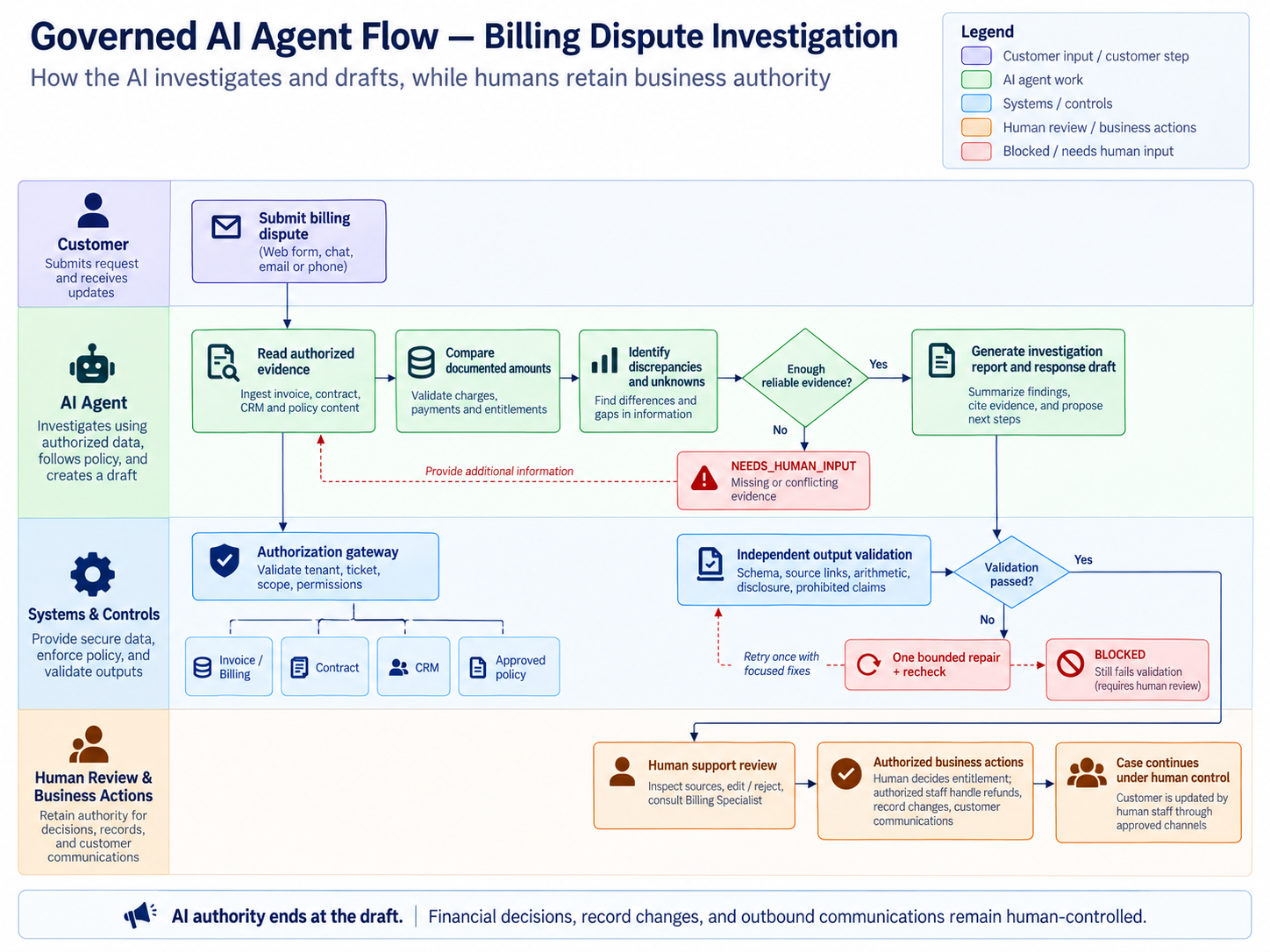
worker: scope: invoice_exception_review autonomy: recommendation_only allowed_reads: - invoice_content - vendor_status - po_data writes: first_pilot: none later_phase: approval_gated blocked_actions: - release_payment - change_bank_details - override_policy audit: ledger: append_only
Example: Invoice Exception Approval
From conflicting approval rules to one human-approved operating baseline.
The example shows how the Studio identifies an older $500 rule and newer $250 / $2,000 tiers, asks an authorized person to confirm the governing source, and preserves the older rule as superseded evidence.
Worked product example—not a customer case study or evidence of quantified business improvement.
Deterministic routing
- ≤ $250 AP low-risk handling
- $250–$2,000 Finance Manager
- > $2,000 Finance Director
Read-only shadow mode
- Read invoice and reference data
- Prepare approval package
- Require human review
Business authority retained
- Never release payment
- Never change bank details
- Never override policy
Start with one painful workflow
Bring the evidence you already have. Leave with the decisions needed to proceed responsibly.
Workflow Readiness Sprint
Determine whether one submitted workflow is coherent enough for a full Blueprint engagement.
- Initial source and conflict review
- Workflow-control gap map
- AI, deterministic, and human responsibility outline
- Initial trust-boundary assessment
- Readiness, pilot posture, and open-decision register
Controlled AI Worker Blueprint Pilot
Turn one exception-heavy workflow into a human-approved operating baseline and governed implementation handoff.
- Canonical SOP Draft and facilitated baseline approval
- Controlled AI Worker Blueprint and Trust Boundary
- Exceptions, risks, audit, and approval requirements
- Pilot posture plus test and acceptance package
- Current JSON, YAML, Markdown/PDF, Mermaid, and test artifacts
Engagement scope and commercial terms are discussed privately after the workflow, evidence volume, stakeholder involvement, and required deliverables have been qualified.
Come with the evidence
Start with one exception-heavy workflow.
Bring the SOPs, policies, emails, notes, transcripts, examples, and known constraints. We will assess whether the submitted workflow is ready for governed AI design and define the safest useful next step.
Book a meeting SOPs, emails, notes, transcripts, examples, and exception logs all work.Common questions
Before you automate.
Does the Studio execute the workflow?
No. Blueprint Studio is the governed preparation and design layer. Execution remains with an automation platform, BPM engine, or custom runtime.
What happens when source documents conflict?
The Studio creates a conflict register and asks which source is authoritative. It does not silently choose or combine contradictory rules.
Does it select the best workflow across the organization?
No. It evaluates the workflow submitted to it and recommends whether and where that workflow should use AI.
Is an exported workflow production-ready?
No export is production-ready until environment bindings, identities, permissions, callbacks, monitoring, fallback, security review, and acceptance tests are complete.
Are n8n and BPMN exports available now?
No. Platform-specific workflow starters are roadmap capabilities until they are implemented, structurally validated, and tested against the target platform.
Can it support security-, safety-, or regulated workflows?
It can prepare and assess them, model their control requirements, and recommend a limited pilot. It does not replace qualified-human review, security validation, domain obligations, or regulatory approval.
Does it eliminate human review?
No. Human approval and professional judgment remain mandatory wherever business authority, material risk, or policy requires them.